
I spent my weekend doing something unpleasant. Sitting with our marketing manager and the reports from the reading panel, we went through over forty new submissions and rejected them all. Contrary to what the recipient of the dreaded ‘Thank you for your submission, but—’ notes, this is not something publishers enjoy doing. No really, not even on a day when our mood is so bad, kicking a wounded puppy sounds like fun, do publishers get a kick out of rejecting a hopeful writer’s offering.
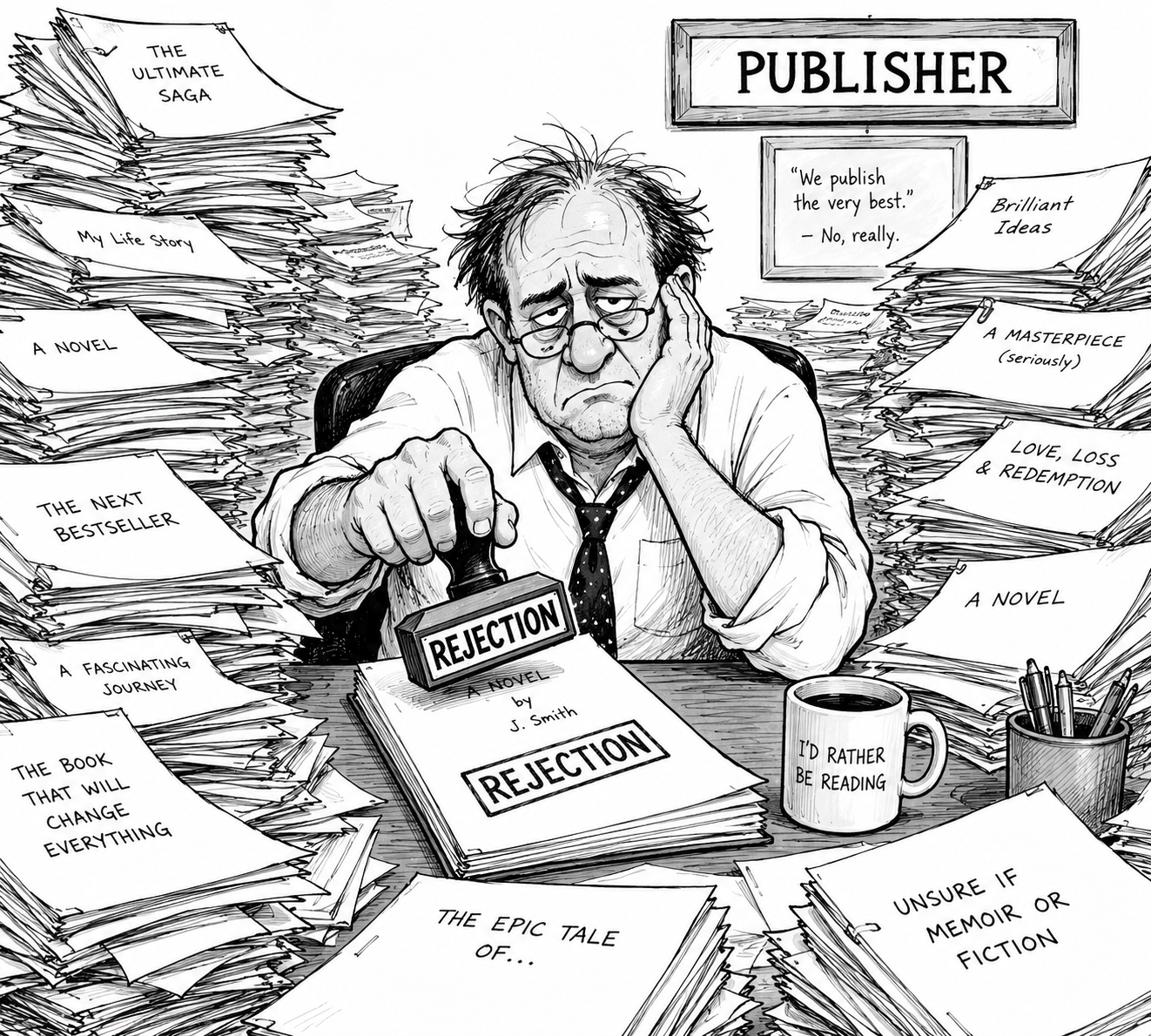
So why does it happen so often? The reasons are legion, but the more I read (and then reject) the more I see trends forming. Let me go through the main ones in the hope of lifting the veil on the arcane world of the commissioning team.
Number one has to be length. In the world of creative writing, where Platonic ideals of how a novel forms abound, length is only dictated by the author’s imagination and skill. Unfortunately, though you may have eagerly boarded the good ship Creative Writing Course, you are about to collide with a Publishing iceberg. Publishers reside inside a nasty space called reality, where grubby things like money are an influence. There is much I could say about the length of novels, but to keep it simple you need to keep to the Goldilocks zone, i.e. not too long and not too short. So what does that actually mean? Well, the cost of printing and distributing books is putting publishers out of business across the world, and so 300,000 word tomes are not going to be our first choice. Equally, the length of a novel cannot be too short. Anything under 50,000 words and you are really in the territory of novella, and this length of book can be hard to sell as the reader feels they are not getting enough meat for their money. Broadly speaking, 80,000 to 100,000 words sits comfortably in the middle. This is not to say that there are not exceptions, but as a new writer any negative you can avoid when submitting will give you a much better chance of being accepted.
Number two would be not bothering to read the Publisher’s guidelines. A subject I will come back to in another article is that publishers are not all the same, and there is a vast difference between the Big Five and the small indies. Every publisher will have guidelines and, though there will be broad similarities, there will also be distinct differences. The guidelines are there to help potential authors. They tell you things to avoid e.g. certain genres, and things to do to make your manuscript more attractive e.g. including a summary. Ignoring these is a sure way to tell the publisher that you chose them at random and have no real interest in their company outlook.
Number three is failing to include a cv. While a large part of me still clings to the idea of books as an intellectual exercise in which minds meet mind without the trappings of the physical world, in reality publishers publish people as much as they publish books. It’s a dog-eat-dog world out there, and publishers struggle to get new authors noticed. They need to hear more about who you are and any information that might help them promote you. If you are writing a crime novel and have spent the last twenty years as a forensic scientist, it’s worth mentioning. That sort of detail can make you stand out from similar submissions.
Number four is the biggie, and the one that most submissions are guilty of: the writing simply isn’t good enough. Recently, we’ve seen some very exciting and original ideas land in our submissions inbox, only to be put off by the quality of the writing. Before you press send on that email, ask yourself if your opening page will blow a reader away. How quickly does it introduce mystery/action/drama. Far too many manuscripts see the opening pages as a means to very slowly build up to the point. Commissioning editors are busy people. If you don’t grab their attention quickly, they will drop you on the slush pile and move on.
Number five is dreadful formatting. Word processors have now been around for decades. There really is no excuse for using spaces or the tab key to indent paragraphs. Paragraphs do not need to be separated by giant spaces so that they float like unrelated islands on the page. Your manuscript is also no place for showing off your typesetting skills. Strange fonts, colours, wandering text, giant chapter headings etc. will motivate no-one to take your manuscript seriously. (The one exception is, of course, if you are submitting a book about weird typesetting.) The word processor is the tool of the modern writer. You need to know how to use one as much as the ancient Mesopotamian scribe had to know how to use clay tablets. Telling Sargon of Akkad that you just felt more comfortable daubing images on the walls of caves tended to be a career ending move. Likewise, demonstrating that your grasp of technology stops with the feather quill will impress no-one. (An additional comment from Sparsile’s typesetter, who says he will marry the first author to use style sheets correctly.)
Is that everything? Alas if only ‘twere so. We could wax lyrical on the submissions letter or the lack of authorial voice, but those must await a later blog. For now, pay heed. It’s hard enough to break through into the world of the traditionally published. You want to be a professional so avoid spoiling your chances with amateurish mistakes.