
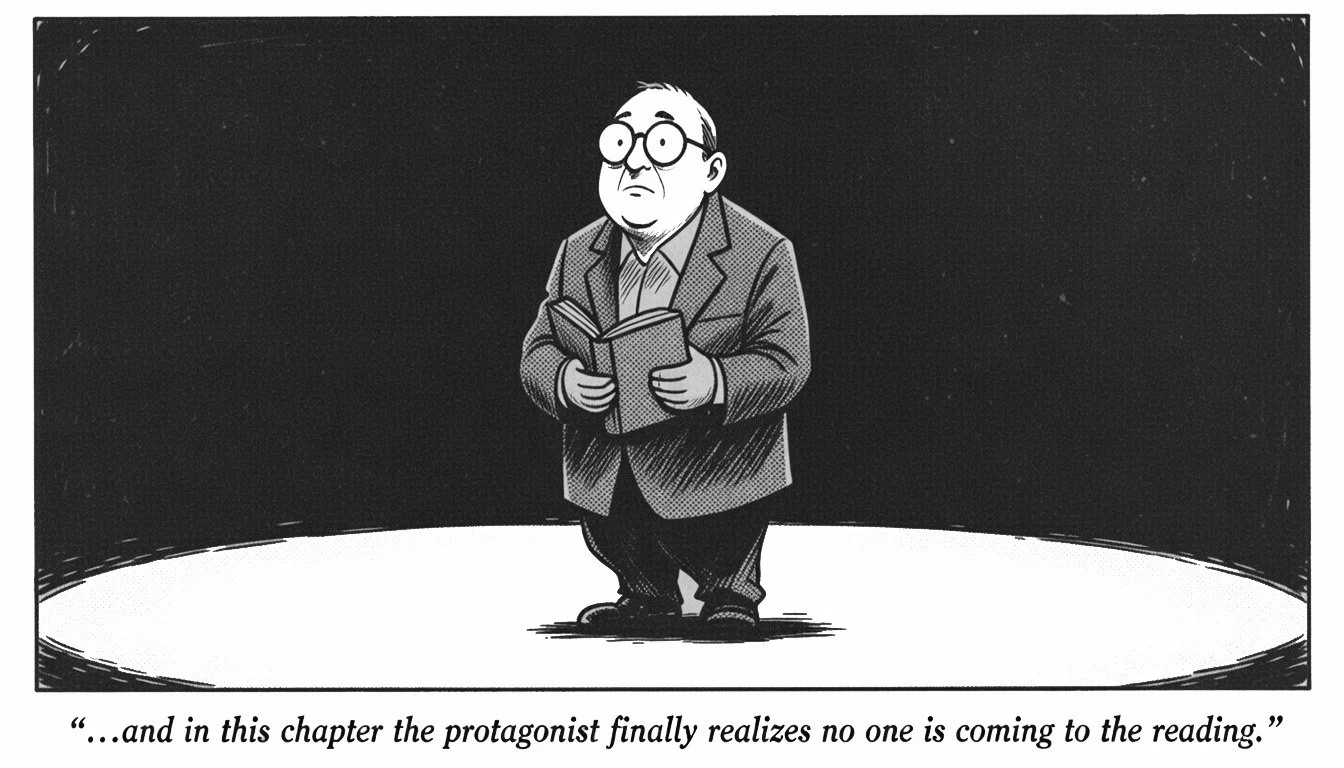
I recently received an invitation to speak to a book group about a novel I wrote nearly fifteen years ago. It came as a surprise — an unusually pleasant one in a world where most surprises seem to involve things costing much more than you’d expect.
As the old adage goes: without an audience, a writer is just a mad person, alone in a room, talking to their imaginary friends. It can be isolating — especially when that inner world of characters and plots and unseen worlds spills out into the external one. I once accidentally terrified a woman in our local supermarket while she was calmly selecting tomatoes. Suddenly she stared at me, wide-eyed, dropped her basket and bolted for the nearest exit. For a moment I was nonplussed. Then I turned as red as the veg (yes, I know they’re technically fruit) when I realised I had been muttering darkly, I will have to kill you. I don’t want to. But I must.
I briefly considered running after her to explain that my words were directed at a central character in my novel — one I had grown too fond of to dispatch as the plot required — but I suspected that might only confirm her worst fears. In that moment, I understood that I had grown so used to my inner world having no audience but itself that my mind now felt entitled to operate my larynx without permission.
And yet, all over the world, writers — published ones included — have no real connection with their audience. As a reader — and a voracious one at that — I am just as irrational. When a passage moves me deeply, I sometimes experience the absurd but persistent sensation that the author somehow knows I am reading it, that there is a faint telepathic tremor passing between us. Of course, this is nonsense. But it’s difficult to shake.
The truth is that authors are the only performers who do not routinely face their audiences. This isn’t entirely accurate. Famous writers may be besieged by adoring followers, risk suffocation under fan mail and have to fend off besotted stalkers. But, in reality, most authors wave their cherished manuscript off into the ether and only a deafening silence comes back.
There are advantages, of course. Never seeing an audience means never having to dodge rotten tomatoes or endure sleepless nights in cheap hotels. But it can be lonely. More than that, it can be limiting. While agents, editors and peers offer valuable feedback, it is not the same as hearing from someone who has chosen the finished article, parted with hard-earned money (albeit probably digitally transferred these days), and taken the time to respond.
I once received a reader review of my novel American Goddess from a woman who said that she had enjoyed it so much she intended to reread it immediately, and though we never met in person, it kept my soul warm for a very long time.
The opportunity to meet and speak with people who have read your book is gold dust. It allows an author to gauge genuine reactions, to notice where readers lean forward and where they hesitate, to understand what resonates and what quietly falters. An isolated writer really is the embodiment of one hand clapping.
So let me give a wholehearted shout out to book groups and reading circles and lecture sessions and reviewers wherever you are. You are not just discussing books; you are keeping modern literature alive and making the connection between author and reader into something real.