
Size does matter…
I have a new submission on my desk—actually I have about six dozen, but that’s another story. The author seems eager and the novel seems interesting. There’s just one stumbling block: it’s 175,000 words long. It’s too long.
Now the moment I post anything on limiting the size of manuscripts our social media channels are generally inundated with cries of horror. You can’t put a limit on art! I get the point. In the shining abstract world of pure art, I agree that an artist should be able to pursue their muse as far as it runs. Trouble is, we don’t live in that world.
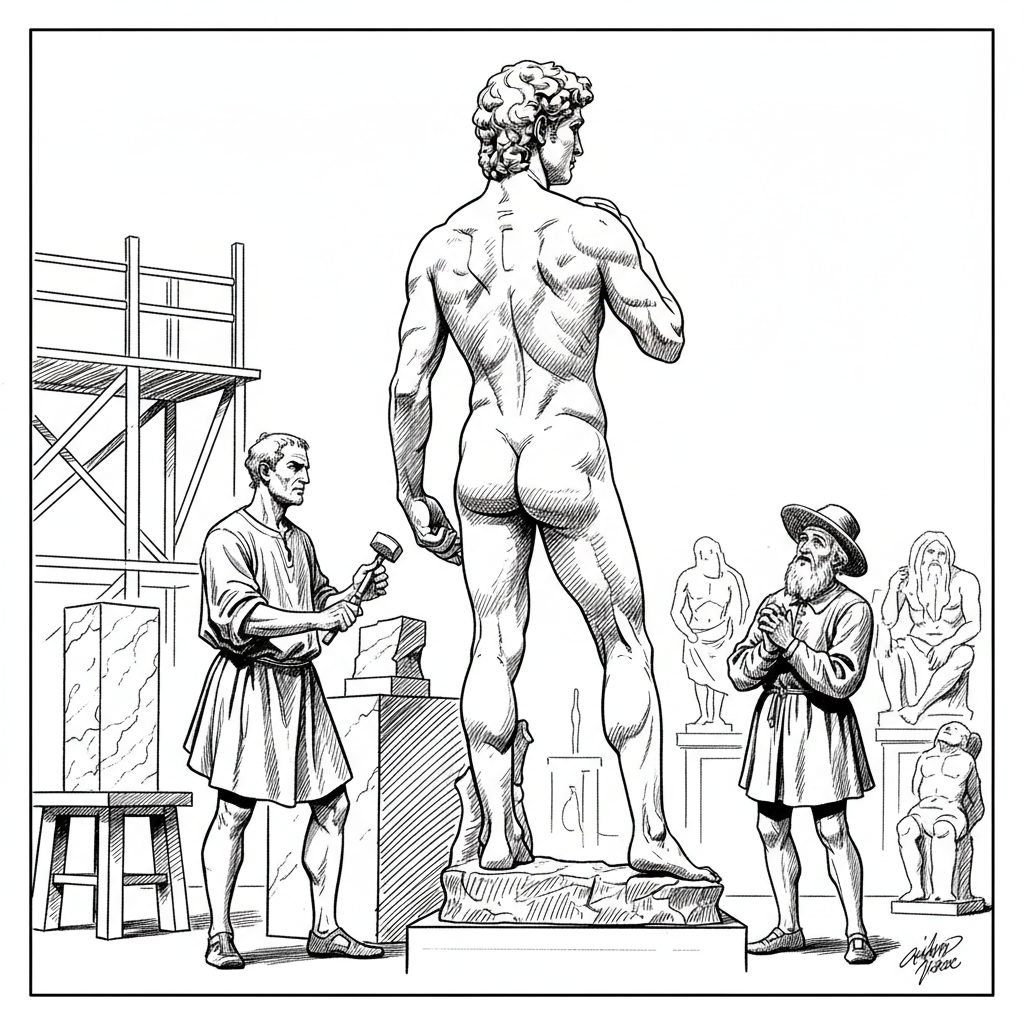
“It’s easy. I just chip away the bits that don’t look like him.”
For some reason, creative writing circles seem to abound with romantic and impractical ideas of what it means to be a writer. Perhaps it is the plethora of Hollywood movies—from Midnight in Paris to Shakespeare in Love—which help fuel these misconceptions. At the same time, publishing as an industry remains astonishingly opaque to new writers—even experienced writers sometimes expect things that seem naïve, such as including the lyrics for a copyrighted song in their manuscript.
The world of publishing and the world of creative writing overlap, but there are massive differences. Creative writing is still the pursuit of a human individual—give or take the odd over ambitious predictive text system. Publishing is a business. Your novel may be fuelled by imagination. A publisher’s world is fuelled by money. But nobody likes to say so. Somewhat like the mores of Victorian high society, talking about money seems vulgar when compared to the lofty world of art. How can a publisher even think about budget when they have the opportunity to nurture talent?
Well, the sad fact is that there won’t be any nurturing talent if the publisher is broke. A business has to meet its costs, staff wages, printing, equipment, software hire, marketing budgets, travel expenses, cover design, affiliations etc, etc. In addition, the cost of paper has been skyrocketing since 2021. (We took a decision to keep our printing in the UK, which means we pay more.) And you can no longer purchase the necessary software, but are forced to hire it on a monthly basis. As always the small houses feel it most. Unable to fund gigantic print runs or mass marketing campaigns, they lose the discounts of bulk orders.
But before this blog turns into a sob story for publishers—or at least before it turns entirely into one; I can feel my lip beginning to tremble— there are other factors to consider. Genres have preferred lengths. Romance, for example, usually sits between 70,000-90,000 words. If you approach a publisher who specializes in that area with a 200,000 word long manuscript, you are making yourself stand out in all the wrong ways.
Another consideration to take into account is whether you are a debut author. A new author is competing against appalling odds at the moment, and one of the main factors is how busy everyone is. Thanks to social media and sites, such as YouTube and Tik Tok, attention spans are becoming shorter. Committing to reading a book by an author you’ve never heard of is a gamble, and it isn’t hard to see that a slim volume will have the competitive edge. Of course, smaller is better is not an absolute rule. 50,000 words is dangerously close to novella length and lacking the content to work as a full-blown narrative. Broadly speaking, a new writer won’t go wrong keeping the manuscript between 80,000-100,000 words.
When it comes down to it, writing as much as you like may seem liberating, but it often allows a narrative to wander and become diffuse. I am no stranger to this. My second novel, Simon’s Wife, was 165,000 words long and I was horrified when told to cut 30,000 words out of it. How could I possibly do it? I prided myself on being a compact writer, every word, every comma agonized over. In fact, on examining the text, there was a lot that could be removed. At the end of the day, the novel was tighter and better paced, and I had learned a lesson. There is a case to be made that what you leave out of a novel is just as important as what you put in.